
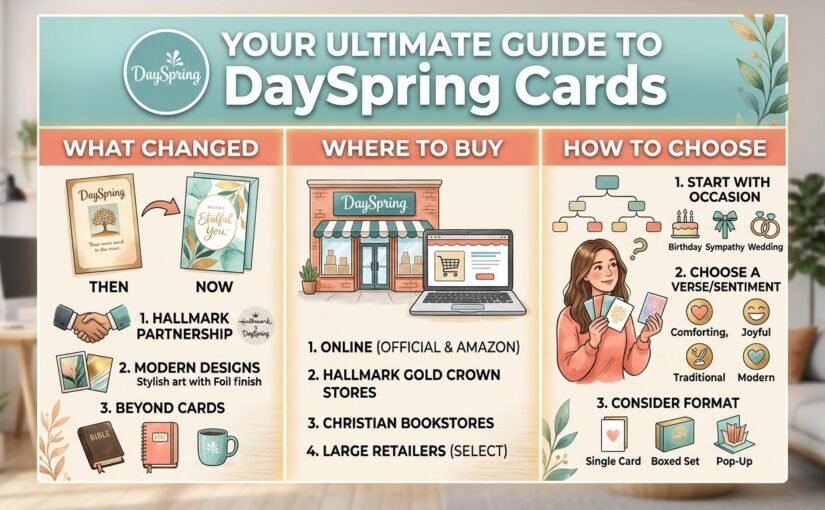
DaySpring cards are Christian greeting cards that pair a personal message with Scripture, made for birthdays, sympathy, encouragement, church life, and the major Christian holidays. DaySpring has belonged to Hallmark since 1999, and in 2026 the shopping experience moved: Hallmark now directs DaySpring shoppers to Hallmark.com, and the old DaySpring e-card service has ended.
If you are here because an old bookmark stopped working, or because you want a faith-based card for a specific moment and are not sure which one to pick, this guide covers both.
Quick Answers
- Who makes DaySpring cards? DaySpring Cards, Inc., a Hallmark subsidiary based in Siloam Springs, Arkansas.
- Where do I buy them now? Primarily on Hallmark.com, plus Christian retailers and some mass retailers.
- Are DaySpring e-cards still available? No. The e-card service ended on February 19, 2026.
- What comes inside? A printed message and, in most designs, a Bible verse. The translation varies by card.
- Single cards or boxed sets? Single cards for one person; boxed sets of 12 or more when you send cards often.
What DaySpring Cards Are
DaySpring began in 1971 in a small commercial print shop in Covina, California. Four Christian men founded it with a shared aim: to make Christ known through the printed message. Its first product was a greeting card, produced that winter. Hallmark acquired the company in July 1999, and it has operated as a Hallmark subsidiary since.
The difference from a mainstream card is the starting point. A DaySpring card is written from a faith perspective, so the verse, the blessing, or the prayer is the heart of the card rather than an add-on. That makes it a natural choice for church friends, ministry teams, and family members who share your faith. It also means it is not the right pick for every recipient, which the selection section below addresses.
What Changed in 2026
Three separate changes happened this year, and they are easy to blur together.
Shopping moved to Hallmark.com. Hallmark’s customer care page tells people to shop for DaySpring products at Hallmark.com and describes the site as the new home for former DaySpring.com shoppers. The benefits it lists include customizable cards, Sign & Send (Hallmark mails the card to your recipient for you), saved addresses, reminders, and the Crown Rewards program.
DaySpring e-cards ended. Hallmark lists the DaySpring e-card service as ended on February 19, 2026. If you relied on it for last-minute digital greetings, the section on alternatives below is for you.
The publishing side was sold. In January 2026, HarperCollins Christian Publishing bought DaySpring Publishing, the arm behind Christian books, journals, and devotionals. Hallmark kept the DaySpring Cards line. In practice: the cards stay with Hallmark, while DaySpring-branded books and journals now come from a different publisher. Hallmark says DaySpring Bibles remain available at the retailers that already carry them, and that DaySpring devotional writing now appears on Hallmark’s Ideas & Inspiration blog.
What You Can Buy
On Hallmark.com, DaySpring cards are sold as individual cards and as boxed sets. The recurring categories include:
- Birthday, in boxed assortments and single cards
- Sympathy, with comforting verses and gentle, restrained messages
- Praying for you and thinking of you, the most flexible categories for encouragement
- Care and concern, for illness or a hard season
- Church occasions, aimed at church friends, ministry teams, outreach volunteers, small group members, and first-time visitors
- Easter, Thanksgiving, and Christmas, including large Christmas boxes
Some lines use licensed artwork, including Peanuts, Thomas Kinkade, and Marjolein Bastin, and one birthday assortment carries messages from pastor and author Tony Evans. If a recipient loves a particular artist or character, that is often the easiest way to narrow a large catalog.
Since it is mid-November, Christmas boxed cards are the most prominent DaySpring listings on Hallmark.com right now, including nativity, Peanuts, and Thomas Kinkade designs. Check the product page for current promotions before you buy, since seasonal offers change quickly.
Where to Buy DaySpring Cards
- Hallmark.com. The main online home for the card line, and the best place to see the full current range.
- Christian bookstores and gift shops. DaySpring has long sold through Christian retail, and Hallmark says to keep looking for DaySpring items, Bibles included, at the retailers that already stock them.
- Mass retailers. Some DaySpring cards also appear on large retail sites such as Walmart.com, though selection varies by store.
- International Christian retailers. UK retailer Eden, for example, lists DaySpring cards and gifts. Availability outside the US depends on the retailer, so check their pages directly.
Related: DaySpring Free Birthday Ecards: How to Send One (and What to Write Inside)
Single Card or Boxed Set?
A single card makes sense when the message has to fit one person and one moment: a sympathy card, a card for a friend’s hard diagnosis, a milestone birthday.
A boxed set makes sense when you send cards regularly. The assortments are typically 12 cards and envelopes, three each of four designs. A recently listed 12-count Easter assortment was priced at $6.99, which works out to under 60 cents per card, while single cards were listed at around $3.99. Prices change, so treat these as a rough comparison rather than a quote.
Boxes are especially practical for:
- Church members who write birthday, anniversary, and sympathy notes through the year
- Ministry and care teams who want something on hand when a need comes up suddenly
- Anyone who prefers to keep a few sympathy or encouragement cards in a drawer rather than shop under pressure
One detail worth checking on any box: the Scripture translation. Some assortments are built around KJV verses, while others use assorted translations. If the recipient is used to a particular version, the product description will tell you.
How to Choose the Right Card
For someone grieving: choose a sympathy card with a calm design and a short verse. Avoid anything that sounds like it is explaining the loss. A plain message of care reads better than a clever one.
For someone ill or struggling: care and concern or praying for you cards work well. They offer comfort without assuming how the person is feeling. Pick the quieter design if you are unsure.
For someone you have not talked to in a while: thinking of you cards are the low-pressure option. They ask for nothing in return.
For a church friend’s birthday: a birthday card with a Scripture verse fits naturally. Mixed boxes let you vary the design from person to person.
For someone who may not share your faith: be honest with yourself about whether a Scripture-centered card will land as kind or as awkward. A warm handwritten note on a gentler design is often the better choice for a friend or coworker who has not mentioned faith.
What to Write Inside a DaySpring Card
The printed message and verse are already doing the faith-based work. Your note should do the part only you can do: say who you are to this person and what you are offering.
A simple three-part method works for almost any card:

- Name something specific. A memory, a quality, or a recent event.
- Say what you are doing. Praying, thinking of them, remembering them.
- Offer something small and real. A call, a visit, a meal, or simply no pressure to reply.
Before: “Thinking of you. Hope you feel better soon.”
After (hypothetical details): “I keep remembering how you sat with me through my surgery last spring. You’ve been on my mind all week. I’m bringing dinner Thursday, and you don’t have to host me.”
The second version has specifics only the sender could write, and it offers something the recipient can say yes to.
Below are original lines you can adapt. Each one is written for a different situation and sentiment.
- Sympathy: “I’m so sorry. There is no right thing to say, so I’ll say that I’m here, today and in the weeks after the cards stop arriving.”
- Illness: “You’ve been on my mind and in my prayers since I heard. Please don’t feel you have to answer. I’ll check in again soon.”
- Hard season: “You don’t have to be okay right now. I’m sending a little encouragement and a promise to keep showing up.”
- Distance: “It has been too long since we talked, and you crossed my mind today. Expect a phone call soon.”
- Birthday, close friend: “Another year of you being the person I call first. Thank you for that. Happy birthday.”
- Birthday, church elder: “Thank you for the way you have welcomed so many people through our church doors. Wishing you a blessed birthday.”
- First-time visitor: “It was a joy to meet you on Sunday. We would love to see you again, and please ask if there is anything we can do to help you settle in.”
- Christmas, neighbor: “Thank you for being a neighbor who notices things. Merry Christmas to you and yours.”
A few cautions:
- Only write “I’m praying for you” if you intend to. People often keep these cards for a long time.
- In sympathy cards, skip lines that explain the loss or promise that things happen for a reason.
- Don’t assume details about the recipient’s family, health, or beliefs. Write only what you actually know.
- Handwrite it when you can. A short personal note matters more than a long one.
What to Do Now That DaySpring E-Cards Have Ended
If you used DaySpring e-cards for quick digital greetings, you have a few options:
- Hallmark e-cards. Hallmark says its Crown Rewards program and Hallmark+ subscription unlock free Hallmark e-cards.
- Sign & Send. Choose a DaySpring card on Hallmark.com and have Hallmark mail it for you, useful for last-minute birthdays or when you live far away.
- A text or voice note, followed by a card. For urgent comfort, reach out right away, then send a paper card so the person has something lasting.
Related: DaySpring eCards: A Complete Guide to Free Christian Greeting Cards
Frequently Asked Questions
Is DaySpring owned by Hallmark?
Yes. Hallmark acquired DaySpring in 1999. In January 2026, Hallmark sold DaySpring Publishing (books, journals, devotionals) to HarperCollins Christian Publishing but kept the DaySpring Cards line.
Can I still shop at DaySpring.com?
Hallmark’s customer care guidance directs shoppers to Hallmark.com for DaySpring products. If you need help with an old account or order, Hallmark Customer Care at care.hallmark.com is the place to ask.
Are DaySpring e-cards still available?
No. The DaySpring e-card service ended on February 19, 2026. Hallmark offers free Hallmark e-cards through Crown Rewards or Hallmark+.
Do DaySpring cards include Bible verses?
Most do. The translation differs by product: some boxed sets feature KJV verses, and others use assorted translations. Check the product description if the version matters to you.
Are DaySpring cards only for Christians?
They are written from a Christian perspective, so they fit best with recipients who will welcome a faith-based message. For a recipient whose beliefs you do not know, a gentler design with a short handwritten note is usually safer.
Where can I find DaySpring Christmas cards?
Hallmark.com’s Christmas card section lists DaySpring boxed sets in nativity, Peanuts, and Thomas Kinkade designs, among others. Christian bookstores also stock seasonal boxes.
The Short Version
DaySpring cards are still around and still faith-centered, but the way you find them has changed. Start at Hallmark.com, pick the category that matches the moment, and add a few honest lines in your own hand. That last part is what the recipient will remember.

2 thoughts on “DaySpring Cards: What Changed, Where to Buy, and How to Choose”